

Short answer: A fireproofing inspection is the special inspection a California building code requires when sprayed fire-resistive material (SFRM) goes on structural steel, decks or walls. The inspector checks the steel before spraying, then tests the cured material for thickness and density (ASTM E605) and bond strength (ASTM E736), and checks it again after other trades finish their rough-in. Under the 2025 California Building Code, Section 1705.15, bond strength must reach at least 150 psf, and no thickness reading may fall below the minimum allowed.
Key takeaways
- SFRM inspection has five parts: substrate, thickness, density, bond strength and the finished condition (CBC 1705.15.1).
- Thickness: no more than 10% of readings under the design thickness, and none under the design minus 1/4 inch (or minus 25% when the design is under 1 inch).
- Sampling is set by area and member: 4 readings per 1,000 sq ft of deck, 25% of members per floor, 1 density and 1 bond sample per 2,500 sq ft.
- Bond strength minimum is 150 psf, rising to 430 psf or 1,000 psf in high-rise buildings.
- In Los Angeles, an SFRM deputy inspector needs a current ICC “86 – Spray Applied Fireproofing” certification.
What a fireproofing inspection covers
Spray-applied fireproofing only earns its fire rating if it is the right thickness, the right density and stays stuck to the steel. That is why the code makes it a special inspection: an independent inspector checks the work against the fire-resistance design on the approved plans, usually a listed assembly such as a UL design.
The 2025 California Building Code (CBC Chapter 17, Section 1705.15) lists five things the inspections and tests must show:
- Condition of the substrate: the steel or deck surface before spraying.
- Thickness of the applied material.
- Density, in pounds per cubic foot.
- Bond strength, meaning adhesion to the steel and cohesion within the material.
- Condition of the finished application.
The code also calls for an extra visual inspection after electrical, sprinkler, mechanical, plumbing and ceiling-hanger rough-in, before anything is covered. That second look exists because other trades knock fireproofing off beams while they work.
This applies to SFRM: the sprayed fiber and cementitious products. Thin-film intumescent coatings are inspected under a different section (CBC 1705.16) using the AWCI 12-B standard, so don’t mix up the two.
Step 1: Before spraying (substrate and conditions)
The inspector looks at the prepared steel before any material goes on (CBC 1705.15.2). The surface has to be prepared the way the fire-resistance design and the manufacturer’s written instructions say. Section 1705.15.3 adds two site conditions from those same instructions: a minimum substrate temperature before and after application, and ventilation during and after spraying.
Primers and paints matter here. If SFRM is going over a primed, painted or encapsulated surface whose bond with that product hasn’t been established, the code calls for bond tests to qualify the coating. If the bond comes in low, a bonding agent approved by the SFRM manufacturer has to go on first (CBC 1705.15.6.3). Sorting this out before spraying is far cheaper than finding it at the bond test.
Step 2: Thickness testing (ASTM E605)
Thickness is measured under ASTM E605, the standard test methods for thickness and density of SFRM. The pass rule in CBC 1705.15.4 and 1705.15.4.1 has two parts:
- No more than 10% of readings may be thinner than the design thickness.
- No reading at all may be thinner than the minimum allowable thickness: design thickness minus 1/4 inch when the design is 1 inch or more, or design thickness minus 25% when the design is under 1 inch.
So a 1-1/4 inch design allows a lowest single reading of 1 inch, and a 3/4 inch design allows a lowest single reading of 9/16 inch.
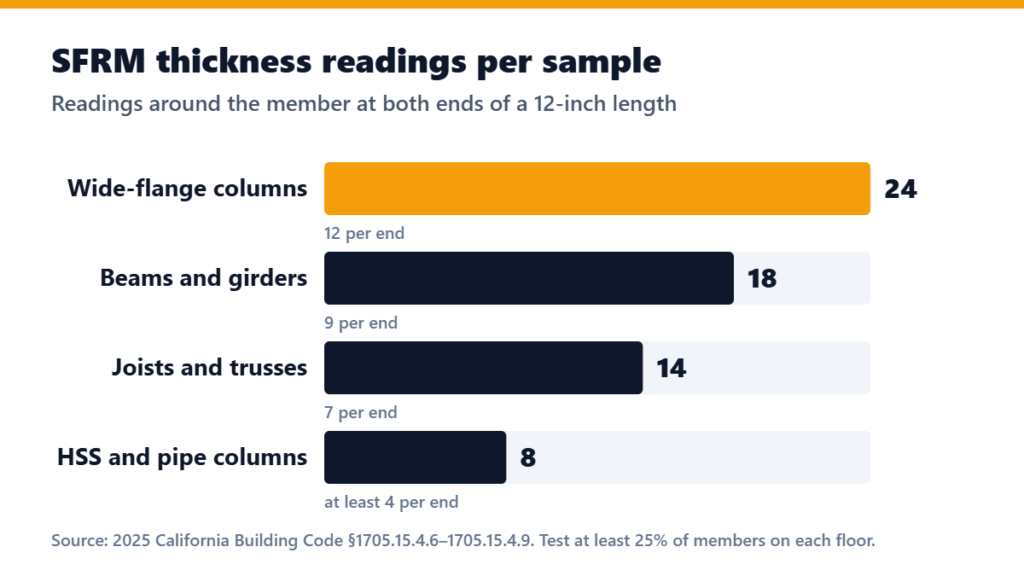
How many readings? Floor, roof and wall assemblies need at least four readings for every 1,000 square feet of sprayed area (or part of it) on each story. On cellular and fluted decks, each set of readings is taken inside a 12 × 12 inch square, at least four readings, and on fluted deck one each at the valley, crest and sides. For structural members, at least 25% of the members on each floor are tested, with readings around the member at each end of a 12-inch length:
Step 3: Density testing
Density is also measured under ASTM E605, and it can’t be lower than the density named in the approved fire-resistance design (CBC 1705.15.5). Samples are taken:
- From each floor, roof and wall assembly: at least one sample per 2,500 square feet of sprayed area (or part of it) on each story.
- From beams, girders, trusses and columns: at least one sample for each type of member per 2,500 square feet of floor area (or part of it) on each story.
Step 4: Bond strength (cohesion/adhesion, ASTM E736)
Bond strength is a pull test on the cured material, run in the field under ASTM E736. It measures how much force it takes to pull the SFRM away, either off the steel (adhesion) or apart within itself (cohesion). The result has to be at least 150 pounds per square foot (CBC 1705.15.6), sampled at the same rates as density.
High-rise buildings need more. Under CBC Section 403.2.3 and Table 403.2.3, SFRM throughout a high-rise must reach 430 psf in buildings up to 420 feet tall and 1,000 psf above 420 feet, measured from the lowest level of fire department vehicle access.
Bypass Municipal Delays Now
All SFRM tests at a glance
| Check | Standard | 2025 CBC section | How often | Passes when |
|---|---|---|---|---|
| Substrate | Fire-resistance design and manufacturer’s instructions | 1705.15.2, 1705.15.3 | Before application | Inspector accepts the prepared surface, temperature and ventilation |
| Thickness, assemblies | ASTM E605 | 1705.15.4.2–1705.15.4.4 | 4 readings per 1,000 sq ft per story | ≤10% under design; none under the minimum allowable |
| Thickness, members | ASTM E605 | 1705.15.4.5–1705.15.4.9 | 25% of members per floor | Same as above |
| Density | ASTM E605 | 1705.15.5 | 1 per 2,500 sq ft per story (assemblies); 1 per member type per 2,500 sq ft (members) | Not less than design density |
| Bond strength | ASTM E736 (field) | 1705.15.6 | Same as density | ≥150 psf (430 or 1,000 psf in high-rises, 403.2.3) |
| Primer or paint bond | Bond tests | 1705.15.6.3 | When the coating’s bond with the SFRM isn’t established | Meets required values, or bonding agent applied |
| Finished condition | Visual | 1705.15.1, 1705.15 | During construction and after MEP rough-in, before concealment | No damaged or missing material |
Worked example: one floor of a steel building
Example numbers, not a real project. One story has 18,000 square feet of sprayed floor deck, 80 beams and 24 wide-flange columns. The design thickness is 1-1/4 inches.
| Item | Math | Minimum on this floor |
|---|---|---|
| Deck thickness readings | 18 × 4 per 1,000 sq ft | 72 readings |
| Lowest single reading allowed | 1.25 in − 0.25 in | 1 inch |
| Readings allowed under 1-1/4 in | 10% of 72 | 7 |
| Beams to test | 25% of 80, 18 readings each | 20 beams, 360 readings |
| Columns to test | 25% of 24, 24 readings each | 6 columns, 144 readings |
| Deck density samples | 18,000 ÷ 2,500 = 7.2, round up | 8 samples |
| Member density samples | 8 per type × 2 types (beams, columns) | 16 samples |
| Bond strength samples | Same as density | 8 deck + 16 members |
The code also caps the sample size at 110% of what the referenced standards specify, so the inspector shouldn’t pile on extra tests beyond that.
Who can do the inspection in Southern California
The inspection is done by a special inspector working for the owner, not the applicator, and accepted by the building official. Nationally, the matching credential is the ICC Spray-applied Fireproofing Special Inspector certification.
The City of Los Angeles is specific. Its deputy inspector bulletin (LADBS P/BC 2026-035, revised July 17, 2026) has a Sprayed Fire-Resistant Materials (SFRM) license that requires a current ICC “86 – Spray Applied Fireproofing” certification. It also says deputies must hold a manufacturer’s own certification where the product maker requires one. Other cities, such as Irvine, Anaheim or Culver City, set their own registration rules, so check with the building department on your permit.
Checklist: get the floor ready for the inspector
- Have the approved fire-resistance design (assembly number, design thickness and density) on site.
- Know what primer or paint is on the steel, and whether the SFRM maker lists it.
- Book the substrate inspection before the sprayer starts, not after.
- Let the material cure per the manufacturer before thickness, density and bond tests.
- Patch thin areas and retest before ceilings, ducts or walls cover them.
- Schedule the post-rough-in visual inspection once MEP, sprinklers and ceiling hangers are in.
- Collect the inspector’s reports for the final special inspection report to the building official.
Requirements vary by jurisdiction, permit and code edition. Your approved plans, statement of special inspections and building official have the final word.
Frequently asked questions
What is a fireproofing inspection?
It’s the special inspection required when sprayed fire-resistive material is applied to structural steel, decks or walls. An independent inspector checks the steel before spraying, tests the cured material for thickness, density and bond strength, and checks it again after other trades finish their rough-in.
What is ASTM E605?
ASTM E605 is the standard test method for measuring the thickness and density of sprayed fire-resistive material on structural members. The California Building Code requires it for SFRM thickness and density tests under Section 1705.15.
What is ASTM E736?
ASTM E736 is the standard test method for the cohesion and adhesion, or bond strength, of sprayed fire-resistive material. In the field, it’s a pull test showing the material won’t come off the steel or split apart.
What is the minimum bond strength for spray fireproofing?
The 2025 California Building Code sets 150 pounds per square foot for SFRM in general. High-rise buildings need 430 psf up to 420 feet tall and 1,000 psf above that.
How many thickness readings are needed on a beam?
Nine readings around the beam at each end of a 12-inch length, so 18 per sample. At least 25% of the members on each floor are tested.
Who can inspect spray fireproofing in Los Angeles?
A deputy inspector registered with LADBS in the Sprayed Fire-Resistant Materials class. That registration requires a current ICC “86 – Spray Applied Fireproofing” certification, plus any certification the product’s manufacturer requires.
Planning a fireproofing inspection?
If your project has SFRM on the steel, see our spray fireproofing inspection services, or our structural steel and welding inspection for the work that comes before it. Questions about your inspection schedule? Contact our dispatch team.
Learn More About This Topic
Related Service: This article is part of our series. For complete service details and reliable care in Garden Grove, explore our service page: Spray Fireproofing Inspection.