

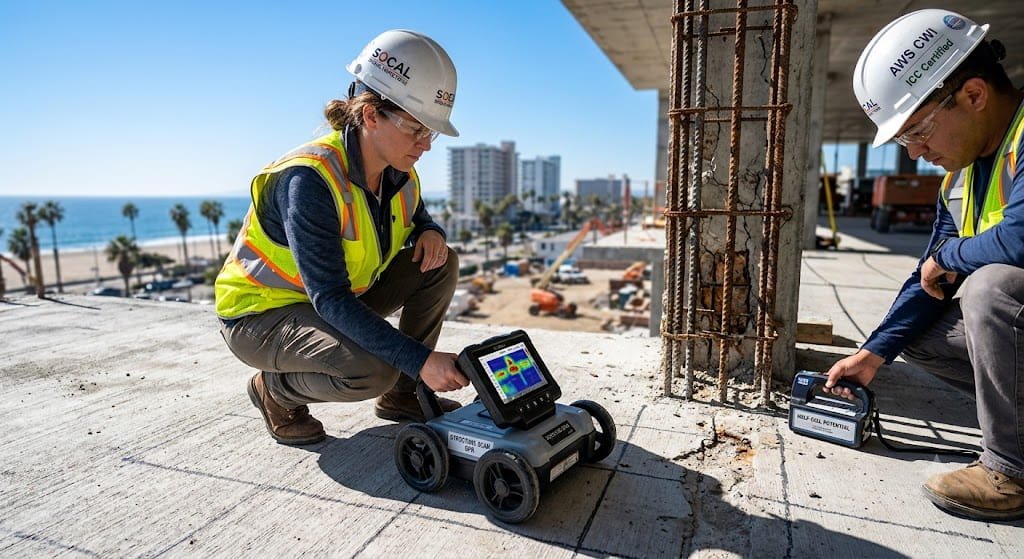
Ground Penetrating Radar (GPR) is utilized to non-destructively assess the structural integrity of reinforced concrete by mapping subsurface rebar networks and identifying areas of delamination prior to visible spalling. In coastal Southern California, airborne chlorides penetrate porous concrete, destroying the passive oxide layer of embedded steel and triggering galvanic corrosion. By deploying advanced GPR and electrochemical diagnostics, structural engineers can pinpoint exact zones of rebar oxidation, allowing for precise, localized repair routing rather than invasive, blind demolition.
The Mechanics of Chloride-Induced Galvanic Corrosion
Coastal Southern California structures are subjected to relentless exposure from marine atmospheric conditions. Over time, chloride ions from airborne saltwater penetrate the microscopic capillary pore structure of the concrete. Once these chlorides reach the embedded steel reinforcement in sufficient concentrations, they break down the highly alkaline, protective passive oxide layer that naturally shields the rebar.
This breakdown triggers galvanic corrosion. An electrochemical cell forms along the rebar, creating distinct anodic and cathodic regions. As the steel oxidizes at the anode, the resulting corrosion byproducts (rust) expand to up to six times the volume of the original steel. This massive internal tensile stress eventually exceeds the structural capacity of the surrounding concrete, resulting in cracking, delamination, and catastrophic spalling.
Non-Destructive Diagnostic Protocols
To accurately assess the extent of subsurface degradation before structural failure occurs, our certified technicians deploy advanced non-destructive evaluation (NDE) protocols. These methods allow us to map the damage and guide targeted concrete repair routing.
Bypass Municipal Delays Now
- Ground Penetrating Radar (GPR) Mapping: GPR utilizes high-frequency electromagnetic pulses to create a 3D subsurface map of the concrete. It precisely locates rebar grids, measures concrete cover depth, and identifies areas of signal attenuation indicative of severe moisture ingress, voiding, or active delamination.
- Half-Cell Potential Testing: This electrochemical method measures the electrical potential difference between the embedded steel rebar and a reference electrode placed on the concrete surface. It effectively maps out active galvanic corrosion “hotspots” even before physical damage is visible on the surface.
- Chloride Profile Core Sampling: While strictly localized, extracting small diameter concrete cores allows for laboratory titration testing. This determines the exact concentration and depth of chloride ion penetration, calculating the remaining service life of the structural element.
Concrete Diagnostic Methodologies Comparison
| Diagnostic Methodology | Primary Detection Target | Application / Structural Output |
| Ground Penetrating Radar (GPR) | Rebar layout, cover depth, subsurface delamination | Non-destructive 3D structural mapping; identifies zones of high moisture/signal attenuation. |
| Half-Cell Potential | Active galvanic corrosion | Electrochemical mapping; pinpoints the highest probability of active oxidation hotspots. |
| Core Sampling & Titration | Chloride ion concentration depth | Laboratory validation; provides a quantitative timeline for when chlorides will breach the rebar depth. |
Precision Repair Routing and Code Compliance
Blindly chipping away spalled concrete without understanding the subsurface corrosion profile often leads to missed structural vulnerabilities and rapid failure of the new patch material.
By utilizing GPR and complementary diagnostics, we provide structural engineers and repair contractors with precise, data-driven mapping. This allows for clinical, localized concrete routing and hydro-demolition—ensuring all oxidized steel is exposed, treated, and structurally restored in strict accordance with ACI 562 repair codes and local Southern California municipal standards.
Subject Matter Context
Core Pillar Connection: This technical guide is part of our Diagnostics & Repair series. For comprehensive execution and guaranteed results in Garden Grove, review our official protocol: REINFORCED CONCRETE.